

Attack Surface Management (ASM) is the discipline of discovering and keeping current the inventory of everything an organization exposes to an attacker, classifying each exposure by the risk it carries. ASM works from the outside in. Rather than auditing what the official inventory records, it looks for what actually exists and then asks who owns it.
In an increasingly digital and decentralized corporate environment, an organization's digital attack surface grows continuously and invisibly. A cloud asset, an exposed API, a temporary machine, a legacy system, an integration with a third party: each one becomes an entry point, often without the security team knowing the asset exists at all.
Accelerated digital transformation, driven by the pandemic and the massive adoption of cloud services, brought agility and scale. It brought a hard question along with it: how do you protect what you do not know exists? Attack Surface Management (ASM) exists to answer that question, which is how it became one of the pillars of cybersecurity maturity.
What Is Attack Surface Management (ASM)?
Attack Surface Management (ASM) is the continuous and automated process of discovering, mapping, classifying, and monitoring the digital assets exposed on the internet by an organization. This includes:
- Domains and subdomains
- Autonomous Systems
- IP prefixes
- Cloud and on-premise servers
- Web applications
- Technologies and services
- APIs
- SSL/TLS certificates
- Third-party resources and the digital supply chain
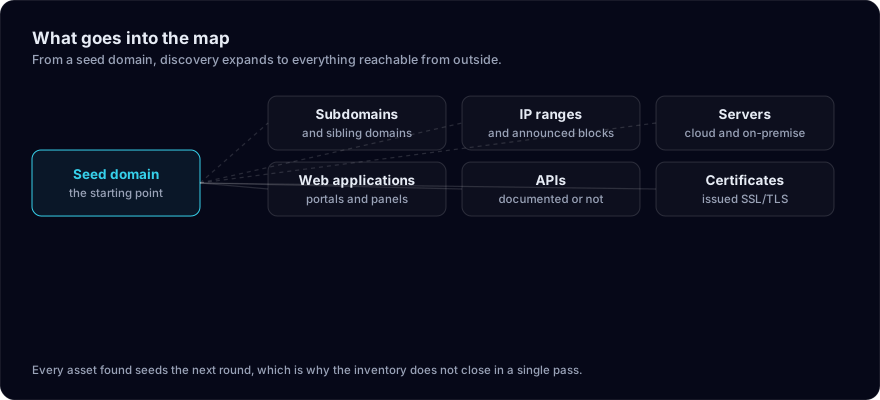
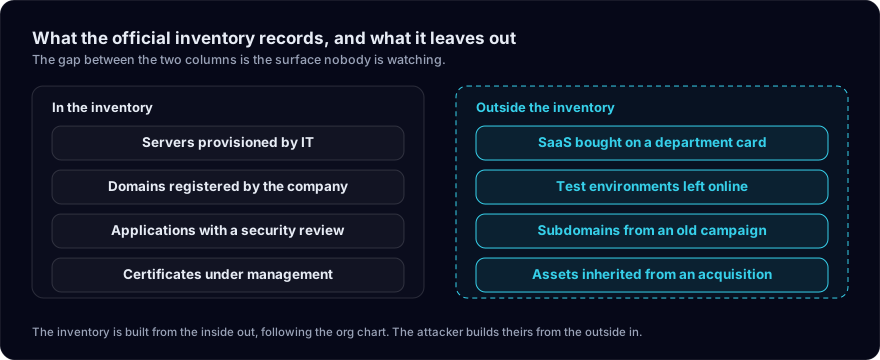
Unlike internal solutions that rely on manually defined inventories or scopes, such as a CMDB, an Attack Surface Management platform operates like an external attacker, mapping everything that is exposed and accessible over the internet, including assets that the organization itself is unaware of or has forgotten.
The Evolution of the Attack Surface Concept
Historically, cybersecurity focused on protecting the corporate network perimeter; firewalls, VPNs, and access controls were sufficient when assets were centralized in physical data centers. However, the dissolution of the traditional perimeter radically changed that paradigm.
With migration to the cloud, the proliferation of IoT devices, remote work, and the adoption of microservice architectures, the attack surface has expanded exponentially. According to Gartner, by 2025, 75% of organizations will have more than 50% of their critical assets outside the traditional perimeter. This fragmentation makes it impossible to maintain an up-to-date manual inventory.
ASM as the Attacker's View
The differentiator of ASM lies in its approach: thinking like an attacker. While traditional vulnerability management tools rely on installed agents and predefined scopes, ASM scans the internet from the outside in, discovering:
- Shadow IT: Services contracted by departments without IT approval
- Forgotten assets: Test servers, exposed development environments
- Mergers and acquisitions: Infrastructure inherited from acquired companies
- Third-party dependencies: CDNs, external DNS, integrated SaaS services
That outside-in view matters because an attacker does not ask permission and does not read your inventory. They work with whatever they find exposed.
Why Is Attack Surface Management Necessary Today?
The question "what is Attack Surface Management" must be accompanied by "why has it become indispensable." Some of the main reasons:
Shadow IT
Users and business units create assets without governance or approval from the security team. According to research by Gartner, 41% of technology purchases are made outside the IT department. These unmanaged assets represent critical blind spots in the security posture.
A common example: marketing teams contract automation platforms that collect customer data but do not go through a security review. These tools may have known vulnerabilities, insecure configurations, or even be compromised without anyone noticing.
Multi-Cloud Environments
Multiple providers make centralized visibility difficult and increase management complexity. Modern organizations frequently use AWS, Azure, Google Cloud, and other providers simultaneously, each with its own interfaces, APIs, and security models.
This fragmentation creates visibility silos: a misconfigured S3 bucket on AWS may go unnoticed while the security team focuses on vulnerabilities in Azure. ASM unifies this view, regardless of where the assets are hosted.
Rapid Expansion
Mergers, acquisitions, and organic growth continuously add assets without updating inventories. When one company acquires another, it inherits the productive assets and a pile of other things:
- Forgotten test environments
- Legacy servers
- Expired or poorly managed domains
- Credentials hardcoded in code repositories
Without an automated discovery process, these assets remain invisible until they are exploited by attackers.
Digital Supply Chain
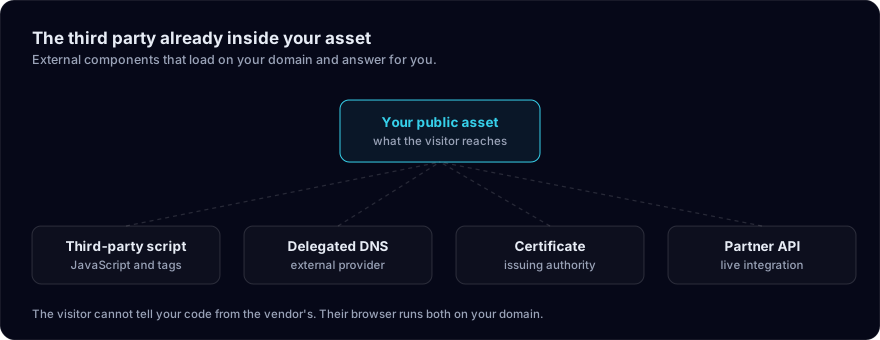
Third-party dependencies (CDNs, DNS, SaaS) expand the attack surface beyond the organization's direct control. Supply chain attacks, such as SolarWinds and Log4Shell, demonstrated that vulnerabilities in suppliers can compromise thousands of organizations simultaneously.
ASM maps these external dependencies, identifying:
- Third-party JavaScript scripts loaded on web pages
- DNS servers managed by external providers
- SSL certificates issued by unauthorized authorities
- Integrations with partner APIs
Complexity of Modern Architectures
Microservices, containers, serverless, and edge computing create a complex web of interdependencies. Each microservice exposes APIs, each container has its own base image with potential vulnerabilities, and serverless functions may have excessive permissions.
Traditional security tools were not designed for this dynamic. An ephemeral container that exists for only a few minutes can be exploited and disappear before being detected. Continuous ASM ensures that even temporary assets are mapped and assessed.
Regulations and Compliance
Frameworks such as LGPD, GDPR, PCI-DSS, and ISO 27001 require organizations to maintain up-to-date inventories of assets that process sensitive data. Failure to demonstrate control over the attack surface can result in significant fines and reputational damage.
ASM automates the collection of evidence for audits, demonstrating that the organization has visibility and control over its exposed assets.
How ASM Works Together with Other Security Initiatives
An Attack Surface Management platform does not replace the tools you already run. It supplies the context and visibility the others cannot capture on their own, and that makes their output better.
Data Enrichment for Vulnerability Management
While traditional vulnerability management tools identify flaws in known assets, ASM discovers unknown assets and provides exposure context. That lets security teams prioritize remediation on three criteria instead of one: severity (CVSS), real internet accessibility, and how critical the asset is to the business.
For example: a critical vulnerability on an internal development server carries a different risk than the same vulnerability on a public web server. ASM provides this layer of context, optimizing the use of limited security resources.
Expanding Visibility for SIEM and SOC
Security Operations Centers (SOCs) rely on logs and alerts from monitored assets. However, uninventoried assets generate no logs. ASM expands the SOC's visibility perimeter by continuously discovering new assets that should be incorporated into monitoring.
Changes in the attack surface also correlate with security events: a new subdomain, a freshly issued SSL certificate, a service that started answering on 443. That correlation is what speeds up detection of malicious activity and unauthorized configuration.
Context for Threat Intelligence
Threat Intelligence feeds provide indicators of compromise (IoCs) such as malicious IPs, phishing domains, and malware hashes. ASM correlates these indicators with the organization's attack surface, answering questions such as:
- Are any of our assets communicating with IPs on block lists?
- Are there typosquatting domains registered that mimic our brand?
- Have fraudulent SSL certificates been issued for our domains?
This correlation turns generic intelligence into specific, prioritized actions.
Support for Governance and Compliance Frameworks
Regulations such as LGPD, GDPR, PCI-DSS, and ISO 27001 require up-to-date inventories of assets that process sensitive data. ASM automates this collection, providing auditable evidence that the organization maintains control over its attack surface.
Reports from ASM platforms also feed the board's risk dashboard. They show how the posture moved over time, which is the argument that carries next year's remediation budget.
Maturing the CTEM (Continuous Threat Exposure Management) Approach
Continuous Threat Exposure Management (CTEM) is a strategic framework introduced by Gartner that proposes a continuous, threat-oriented approach to managing security exposures. Unlike point-in-time assessments (such as annual pentests), CTEM operates in five cyclical stages:
- Scoping: define what to protect (critical assets, sensitive data)
- Discovery: identify assets, vulnerabilities, and configurations
- Prioritization: classify exposures by real business risk
- Validation: test whether the exposures are actually exploitable
- Mobilization: orchestrate remediation and communicate risk
ASM is the fundamental pillar of the Discovery and Scoping stages of CTEM. Without complete visibility into the attack surface, it is impossible to define an adequate scope or discover all exposures. Organizations that adopt ASM as the foundation of their CTEM strategy are able to:
- Reduce the average time to discover new assets and exposures
- Prioritize remediation by real exposure rather than by theoretical severity
- Continuously validate whether infrastructure changes introduce new risks
- Demonstrate maturity in security to stakeholders, investors, and auditors
According to Gartner, by 2026, organizations that adopt CTEM will reduce their likelihood of suffering a data breach by two-thirds. ASM is the first step on that path, and the hardest one to skip.
Conclusion
The attack surface grows faster than anyone can manage it by hand, and that is what pulled Attack Surface Management out of the optional column. An organization that cannot see its own exposed assets works blind and spends the year reacting to incidents instead of preventing them.
ASM goes past asset discovery. It changes where you stand when you look: inside-out becomes outside-in, the way the attacker looks. Risk surfaces before it is exploited, and the adversary's window of opportunity gets shorter.
ASM also gives the security team numbers to bring to the table: how much risk came down, where the money went, what moved between one quarter and the next. That is the practical difference between an organization that reacts and one that gets ahead.
The question is no longer "why implement ASM?", but rather "how long can your organization afford to operate without it?"