

Gartner's security prioritization matrix is the tool that plots the value of a control against how easy it is to deploy, sorting initiatives into four quadrants: quick wins, strategic projects, hygiene, and low-return items. It exists to answer what to do first with the team and the budget you have today.
A security team's to-do list is endless and its resources are not. Thousands of vulnerabilities, hundreds of alerts, pressure for results: what do you do first? The wrong choice burns time and budget and leaves the organization exposed on top of it.
To navigate this complexity, IT and security leaders often turn to strategic frameworks, and few are as clear and effective as the Gartner Project Prioritization Matrix. This tool classifies initiatives based on their impact and the effort required to implement them, helping you focus on what truly matters.
This article uses the logic of the Gartner matrix to show why adopting an Attack Surface Management (ASM) platform such as CSURFACE is the most strategic Quick Win available to your team today.
The Gartner Prioritization Matrix: A Guide to Action
The Gartner matrix is a simple yet powerful visual tool that divides initiatives into four distinct quadrants, based on two critical axes: Impact (the value the initiative adds to the business) and Effort (the resources required to carry it out).
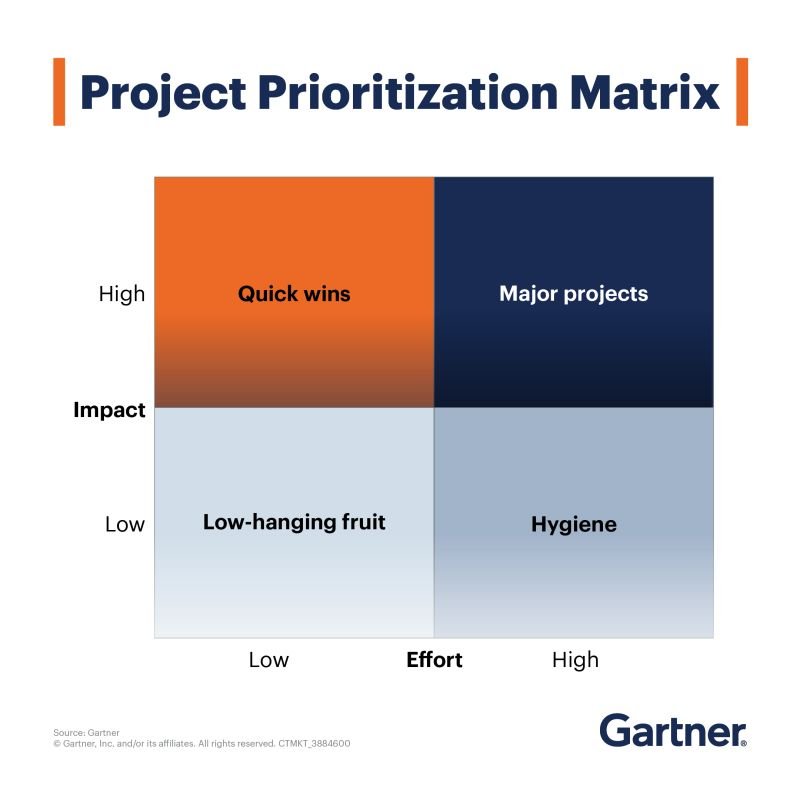
The four quadrants are:
- Quick Wins (High Impact, Low Effort): High-priority initiatives that deliver significant value with minimal resources. They should be executed immediately.
- Major Projects (High Impact, High Effort): Strategic, transformational projects that require careful planning and substantial investment.
- Low-Hanging Fruit (Low Impact, Low Effort): Fill-in tasks that can be done when there is time, but should not divert the main focus.
- Hygiene (High Effort, Low Impact): Activities that consume many resources for minimal return. They should be questioned, automated, or eliminated.
The challenge for any security leader is to ensure that their efforts are concentrated in the two upper quadrants, especially the "Quick Wins." Yet many security teams, without realizing it, spend most of their time on "Hygiene" tasks.
The "Hygiene" Quadrant: Where Traditional Security Drowns
Many cybersecurity practices, however well-intentioned, fall squarely into the "Hygiene" quadrant. They consume enormous effort for an impact that is, at best, limited and, at worst, illusory.
Consider these common tasks:
- CVSS-based Vulnerability Management: Security teams deal with an average of 15,000 vulnerabilities [1]. Trying to analyze and remediate each one based on a generic CVSS score is a Herculean task (High Effort), and the problem lies in the fact that most of these vulnerabilities will never be exploited, resulting in very low real impact on risk reduction.
- Manual Asset Inventory: Trying to keep an up-to-date spreadsheet of every digital asset is a losing battle. With the explosion of cloud services, Shadow IT, and remote work, it is impossible to do this manually (High Effort). The result is a chronically incomplete inventory, and it is where the external asset nobody knew about comes from.
- Sole Reliance on Periodic Scans: Traditional approaches that rely solely on active scans (weekly or monthly) create dangerous windows of invisibility. The problem is not the scan itself, but the lack of visibility between cycles. A new critical vulnerability can be mass-exploited in as little as 5 days [3], a period during which a weekly scan would leave the organization completely blind. This reactive approach offers low impact on preventing emerging threats. In contrast, CSURFACE overcomes this limitation by integrating its active scans with continuous 0-day threat monitoring and passive scans multiple times a day, ensuring much faster detection and closing these critical exposure windows.
These activities create a false sense of security, keeping teams busy with low-impact tasks while the true attack surface, the one attackers actually see, remains unprotected.
ASM as the Ultimate "Quick Win"
This is where Attack Surface Management (ASM) comes in, positioning itself firmly in the Quick Wins (High Impact, Low Effort) quadrant.
An ASM platform such as CSURFACE inverts the equation. Instead of starting from the inside out with an endless list of tasks, it adopts the attacker's outside-in perspective to focus on what is actually exploitable.
Why Is ASM High Impact?
The impact of an ASM platform is immediate and measurable, directly addressing the most critical pain points of modern security:
| Critical Pain Point | Impact of the ASM Platform (CSURFACE) |
| :--- | :--- |
| Invisible assets (Shadow IT) | Continuous discovery of the assets that answer on the internet, including domains, subdomains, IPs, cloud services and shadow IT, going after the blind spot that has already compromised 69% of organizations [2]. |
| Attacker speed | Reduction of exposure time (MTTR) by 73%. Through its continuous monitoring, CSURFACE detects exploitable vulnerabilities at an accelerated pace, giving teams the time they need to act before attackers. |
| Ineffective prioritization | Focus on what really matters. Instead of 15,000 generic alerts, CSURFACE uses a predictive model that considers exploitation likelihood, enabling an 85% reduction in unprioritized risk. |
| Financial impact of incidents | Prevention of incidents that cost, on average, USD 4.44 million [4]. The ROI is direct and substantial. |
Why Is ASM Low Effort?
"Low effort" is perhaps the most transformative aspect of modern ASM. Platforms such as CSURFACE are designed for automation and autonomy:
- SaaS Deployment: No infrastructure to install or manage. The platform is operational in minutes.
- Automated Discovery: The discovery process is continuous and requires no manual configuration or data feeding. The platform finds your assets on its own.
- Zero Ongoing Effort: Once configured, the platform monitors the attack surface 24/7 without human intervention, freeing the security team to focus on strategic remediation.
Unlike traditional tools that add more work, an effective ASM platform removes work, automating "Hygiene" tasks and allowing the team to concentrate on high-impact actions.
Conclusion: Move from Effort to Impact
The Gartner matrix makes one point, and it is about where the effort lands. A team that spends the quarter on "Hygiene" tasks stays in the reactive cycle, one step behind the attacker, however many hours it puts in.
Adopting an Attack Surface Management platform such as CSURFACE is a strategic decision to move your team from the high-effort, low-impact quadrant to the low-effort, high-impact one. It is the definition of a Quick Win: it goes in fast, costs little, and moves the security posture inside the same week.
If your team is spinning its wheels today, the first step is to look at what it still cannot see. Schedule a CSURFACE demonstration.
References
- Statista. (2023). Number of common vulnerabilities and exposures (CVE) listed worldwide from 1999 to 2023. Access Source
- ESG and Randori. (2022). The State of Attack Surface Management 2022. Access Source
- Kenna Security & Cyentia Institute. (2021). Prioritization to Prediction, Volume 8: Measuring and Minimizing Exploitability. Access Source
- IBM. (2025). Cost of a Data Breach Report 2025. Access Source